The Strange Case of Dr Jekyll and Mr Hyde
A deep dive into Stevenson's masterpiece exploring the duality of human nature, Victorian hypocrisy, and the dangers of unchecked scientific ambition. This guide provides the critical analysis and contextual links needed to achieve top marks in your GCSE Literature exam.
Study Notes
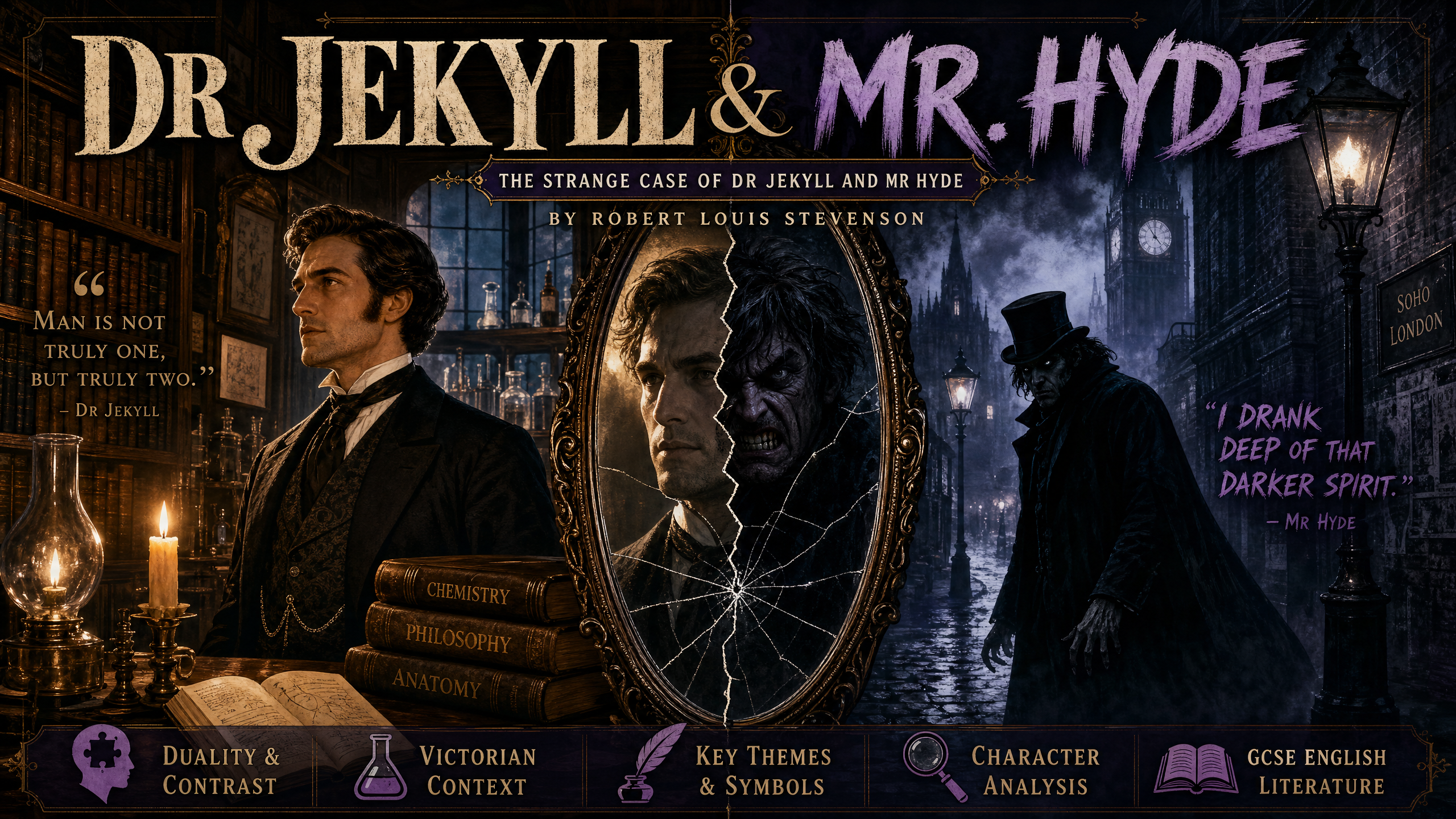
Overview
Robert Louis Stevenson's The Strange Case of Dr Jekyll and Mr Hyde (1886) is a seminal text in the Gothic genre that explores the terrifying possibility that good and evil exist simultaneously within every individual. For examiners, a top-band response requires moving beyond simple character descriptions to analyse how Stevenson uses the novella's epistolary structure, atmospheric settings, and symbolic characters to critique the repressive nature of Victorian society. Candidates are rewarded for sustained critical engagement, particularly when exploring the text's ambiguity and the tension between scientific progress and religious orthodoxy.
Plot/Content Overview
Chapter 1: Story of the Door - Utterson and Enfield walk past a sinister door. Enfield recounts how a man named Hyde trampled a young girl and paid compensation using a cheque signed by Utterson's friend, Dr Jekyll.
Chapter 2: Search for Mr Hyde - Utterson reviews Jekyll's will, which leaves everything to Hyde. He stakes out the door, meets Hyde, and is disturbed by his "ape-like" appearance.
Chapter 3: Dr Jekyll Was Quite at Ease - Utterson questions Jekyll about the will. Jekyll dismisses his concerns, claiming he can be rid of Hyde whenever he chooses.
Chapter 4: The Carew Murder Case - A year later, Hyde brutally murders Sir Danvers Carew. Utterson leads the police to Hyde's rooms in Soho, but Hyde has vanished.
Chapter 5: Incident of the Letter - Jekyll appears deathly ill and gives Utterson a letter supposedly from Hyde, saying he has escaped. Utterson's clerk, Guest, notices the handwriting matches Jekyll's.
Chapter 6: Remarkable Incident of Dr Lanyon - Jekyll becomes sociable again, then suddenly isolates himself. Lanyon dies of a terrible shock, leaving Utterson a letter not to be opened until Jekyll's death or disappearance.
Chapter 7: Incident at the Window - Utterson and Enfield see Jekyll at his window. He is suddenly struck by a look of abject terror and slams the window shut.
Chapter 8: The Last Night - Poole, Jekyll's butler, fetches Utterson. They break down the laboratory door and find Hyde's twitching body. Jekyll is nowhere to be found, but leaves a confession.
Chapter 9: Dr Lanyon's Narrative - Lanyon's letter reveals he watched Hyde drink a potion and transform into Jekyll, causing the shock that killed him.
Chapter 10: Henry Jekyll's Full Statement of the Case - Jekyll's confession explains his lifelong struggle with his dual nature, his creation of the potion, and his ultimate loss of control to Hyde.
Themes
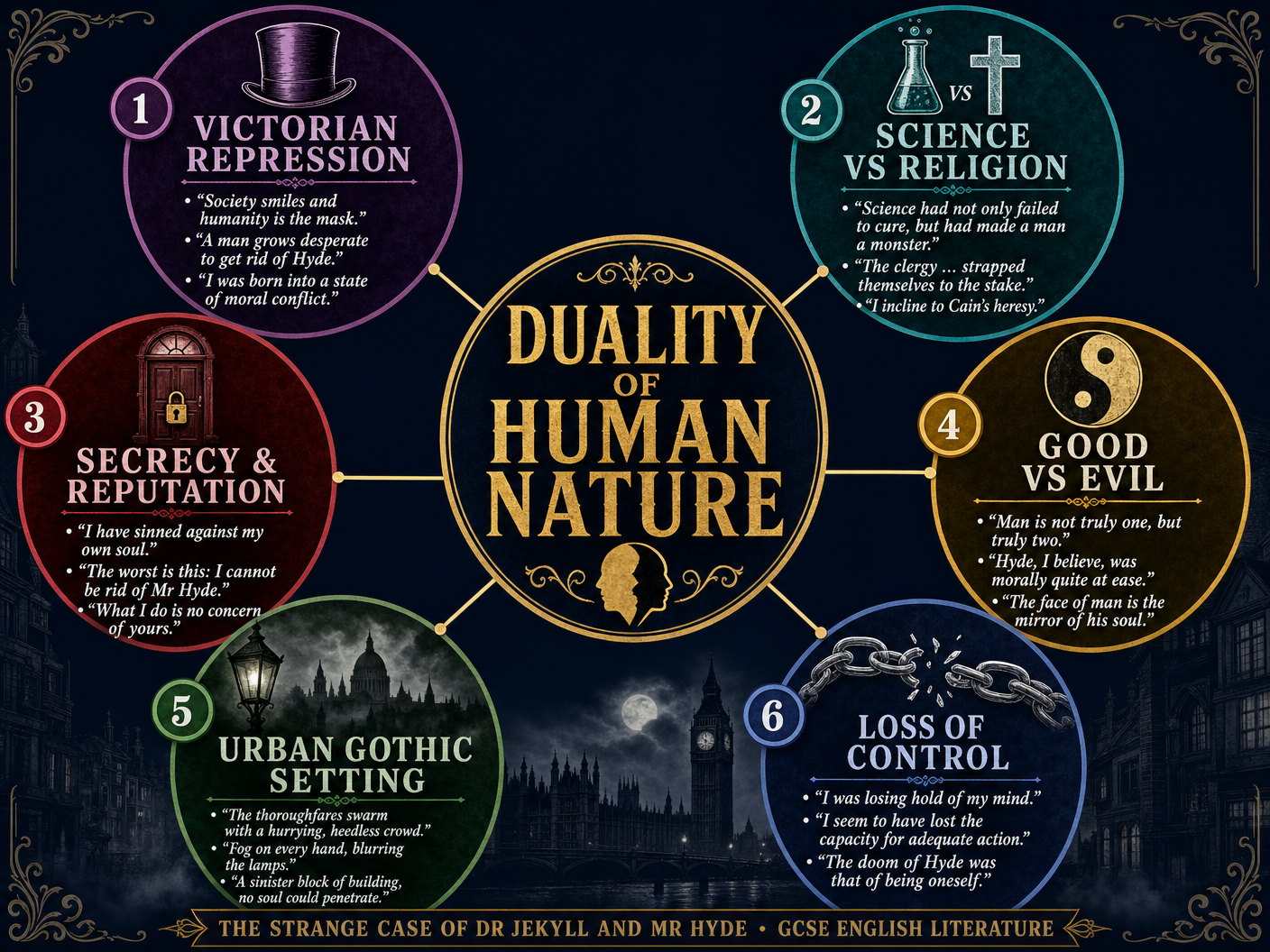
Theme 1: The Duality of Human Nature
Stevenson's central argument is that the human soul is not a single, unified entity, but a battleground between civilised morality and primitive instinct. Jekyll's tragedy is his attempt to separate these elements, which only gives his darker side (Hyde) the freedom to grow stronger.
Key Quotes:
- "Man is not truly one, but truly two." (Chapter 10) - Jekyll's definitive statement on the human condition. The repetition of "truly" emphasises the fundamental nature of this duality.
- "I learned to recognise the thorough and primitive duality of man." (Chapter 10) - Highlights the evolutionary anxieties of the period; the "primitive" aspect suggests regression to a less evolved state.
Theme 2: Science vs Religion
The novella reflects the Victorian crisis of faith following Darwin's Origin of Species. Jekyll's science is "transcendental" and "mystic"—it challenges the boundaries of God's creation. Lanyon represents orthodox, rational science and cannot survive the revelation of Jekyll's supernatural experiment.
Key Quotes:
- "Such unscientific balderdash." (Chapter 2) - Lanyon's dismissal of Jekyll's work, showing the divide between traditional and radical science.
- "The trembling immateriality, the mist-like transience, of this seemingly so solid body in which we walk attired." (Chapter 10) - Jekyll's view of the physical body as fragile and mutable, challenging religious notions of the soul.
Theme 3: Secrecy and Reputation
Victorian gentlemen were expected to maintain an impeccable public image. The novella is driven by the lengths to which characters will go to protect their reputations. Utterson repeatedly suppresses information to protect Jekyll, showing how the obsession with reputation enables evil to flourish.
Key Quotes:
- "I incline to Cain's heresy... I let my brother go to the devil in his own way." (Chapter 1) - Utterson's policy of non-interference, which allows the tragedy to unfold.
- "If it came to a trial, your name might appear." (Chapter 4) - Utterson's primary concern after Carew's murder is Jekyll's reputation, not justice.
Character Analysis
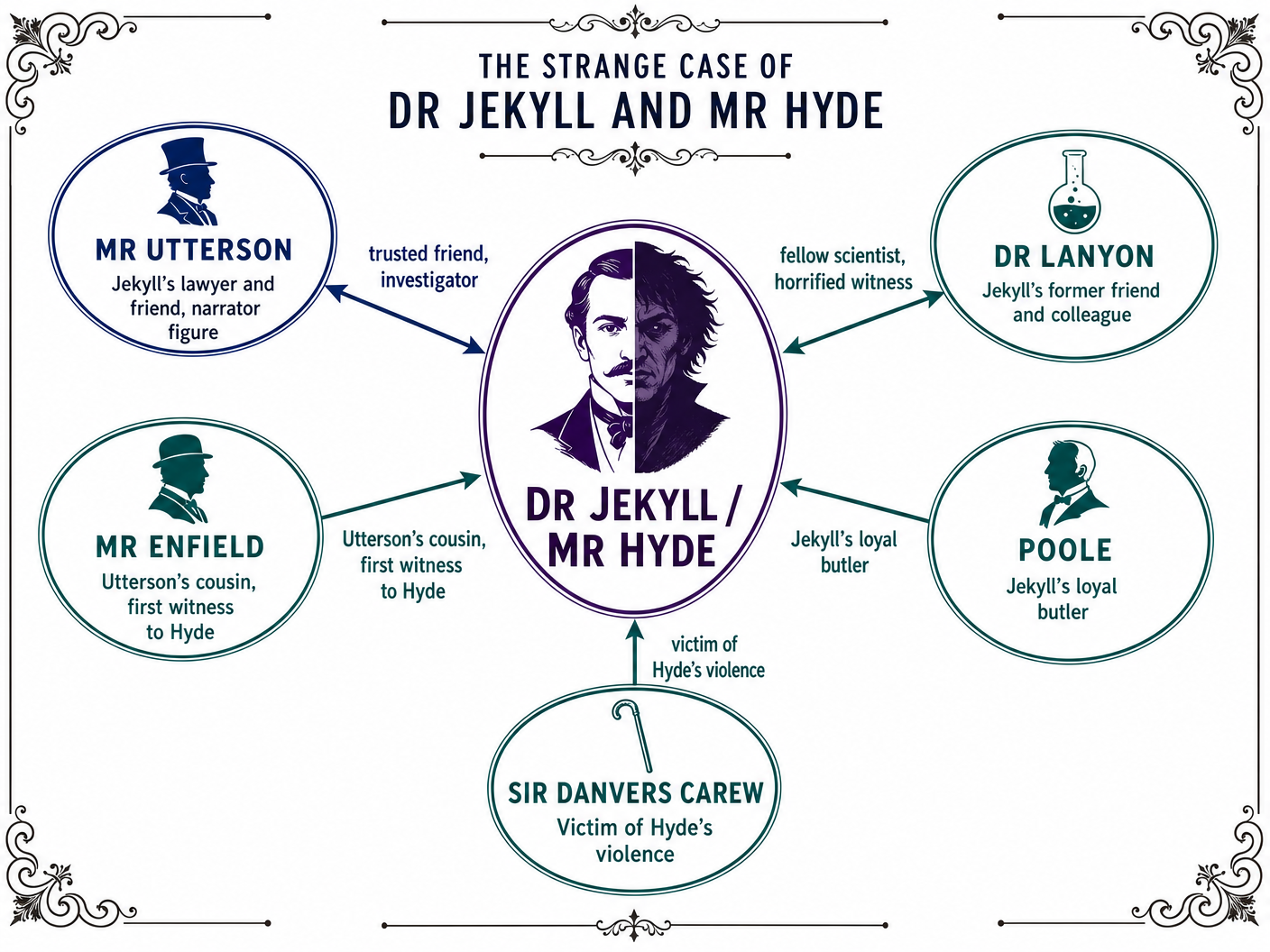
Dr Henry Jekyll
Role: The tragic protagonist; a respected doctor whose ambition leads to his destruction.
Key Traits: Ambitious, repressed, hypocritical, ultimately desperate.
Character Arc: Moves from arrogant confidence in his scientific mastery to abject terror as he loses control of his own identity.
Essential Quotes:
- "A large, well-made, smooth-faced man of fifty, with something of a slyish cast perhaps, but every mark of capacity and kindness." (Chapter 3)
- "I was slowly losing hold of my original and better self, and becoming slowly incorporated with my second and worse." (Chapter 10)
Mr Edward Hyde
Role: The physical manifestation of Jekyll's repressed evil; the antagonist.
Key Traits: Violent, primitive, unapologetic, physically repulsive.
Character Arc: Begins as a smaller, weaker aspect of Jekyll, but grows in strength and stature until he completely dominates their shared existence.
Essential Quotes:
- "Mr Hyde was pale and dwarfish, he gave an impression of deformity without any nameable malformation." (Chapter 2)
- "With ape-like fury, he was trampling his victim under foot." (Chapter 4)
Mr Gabriel Utterson
Role: The primary narrator and investigator; the embodiment of Victorian rationality.
Key Traits: Loyal, logical, emotionally repressed, protective of reputation.
Character Arc: His rational worldview is gradually dismantled as he is forced to confront the supernatural reality of Jekyll's experiment.
Essential Quotes:
- "A man of a rugged countenance that was never lighted by a smile; cold, scanty and embarrassed in discourse; backward in sentiment; lean, long, dusty, dreary and yet somehow lovable." (Chapter 1)
- "If he be Mr Hyde... I shall be Mr Seek." (Chapter 2)
Writer's Methods
Epistolary Structure: Stevenson uses multiple narrators and embedded documents (Lanyon's letter, Jekyll's statement) to delay the final revelation. This creates suspense and forces the reader to act as an investigator alongside Utterson.
Setting and Pathetic Fallacy: London is depicted as a labyrinthine, foggy, nightmare city. The "chocolate-coloured pall" of fog obscures vision and morality, reflecting the secrecy of the characters.
Symbolism of the House: Jekyll's house is a physical representation of his psyche. The respectable front door represents his public face, while the neglected, blistered back door used by Hyde represents his hidden, shameful desires.
Context
Victorian Hypocrisy: The rigid moral codes of the era meant that middle-class men often led double lives, maintaining respectability by day while indulging in illicit behaviours by night.
Evolutionary Anxiety: Following Darwin's publications, there was widespread fear of 'degeneration'—the idea that humans could evolve backwards into primitive beasts. Hyde's "ape-like" descriptions tap directly into this fear.
Gothic Tradition: Stevenson builds on the Gothic tradition of the double (the doppelgänger), using urban settings rather than ruined castles to bring the horror closer to home for his contemporary readers.
Visual Resources
2 diagrams and illustrations
Interactive Diagrams
1 interactive diagram to visualise key concepts
Conceptual Flow Outline
The tragic trajectory of Jekyll's loss of control over his dual nature.
Worked Examples
2 detailed examples with solutions and examiner commentary
Practice Questions
Test your understanding — click to reveal model answers
Starting with this extract (from Chapter 10, Jekyll's confession regarding his dual nature), explore how Stevenson presents the conflict between good and evil. Write about:
- how the conflict is presented in this extract
- how the conflict is presented in the novella as a whole
Hint: Consider how Jekyll initially views the separation of good and evil as a scientific triumph, but how it ultimately becomes a battle he cannot win.
Explore how Stevenson uses the setting of London to create a sense of mystery and fear.
Hint: Look at the contrast between the respectable streets and the dark alleys, and focus heavily on the descriptions of fog and darkness.